Every system, no matter how well-engineered, will eventually fail. The question isn't whether your digital tools will go down — it's whether your operation is ready when they do.
In industries where accountability is non-negotiable — logistics, healthcare, legal evidence handling, waste management — the chain of custody is sacred. Every handoff, every movement, every decision must be documented. A gap in the record isn't just an inconvenience; it can mean regulatory fines, legal liability, or a complete breakdown of trust.
So what happens when the app that powers all of that simply stops working?
Most organizations spend enormous effort designing their digital systems and very little designing what happens when those systems fail. The assumption — often unstated — is that downtime will be brief, rare, and manageable. In practice, it's none of those things.
When a digital custody-tracking app goes offline, operations don't stop. Drivers still make pickups. Materials still move. Decisions are still made. But without a formal mechanism to capture those events, every transaction that happens during the outage becomes a question mark in the record — a gap that must later be explained, reconstructed, or defended.
The solution isn't to hope the gap doesn't matter. It's to design a bridge across it.

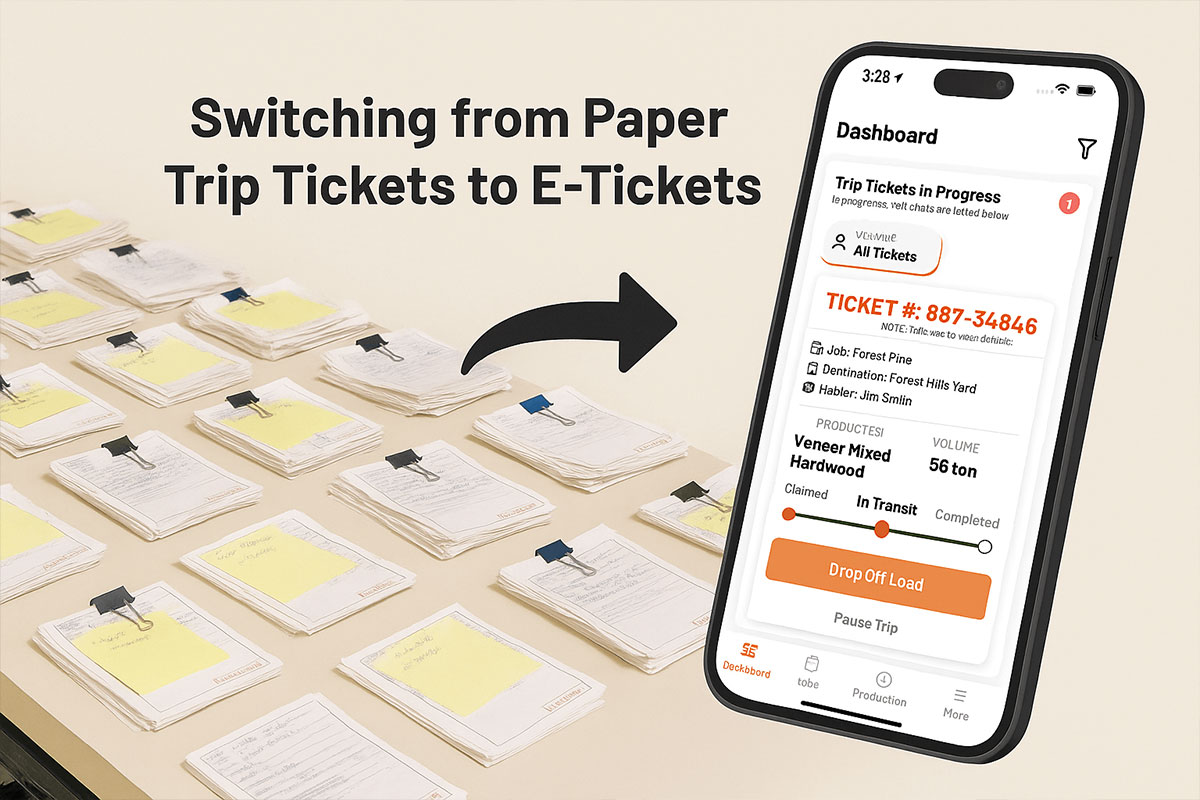
The three-phase model: Normal Operation → Paper Backup Active → System Restored. When the digital app fails, the chain of custody shifts to paper tickets and is imported back once the app is restored.
The diagram above illustrates a resilience model built around a simple insight: the chain of custody doesn't need to be digital to be valid — it just needs to be unbroken. By designing an explicit paper fallback path, organizations can absorb a digital failure without creating a gap in accountability.
Normal Operation
The digital app captures every transaction in real time. The chain of custody begins and flows through the system automatically.
Paper Backup Active
When the app fails, operations shift to physical trip tickets. Each handoff is recorded on paper, maintaining the sequence of custody even without connectivity.
System Restored
Once the app comes back online, all paper tickets are scanned and imported. The digital record is made whole — as if the disruption never occurred.
What makes this model powerful is that neither phase is treated as an exception. Phase 2 isn't a crisis — it's a defined, practiced mode of operation. Drivers know what to do. Dispatchers know what to expect. And when the system comes back, the import process is straightforward because the paper tickets were designed to feed directly back into the digital record.
There's a reason paper has survived every wave of digitization: it doesn't require a server, a network, or a battery. In the field, during an outage, a pre-printed trip ticket is more reliable than any app. It can be filled out in the rain, signed with a wet pen, and stuffed into a glove compartment — and it will still be legible and legally defensible when everything comes back online.
The key is that the paper ticket isn't an afterthought. It's designed to capture the same information as the digital record. When it's scanned back in, there's no translation required — just verification and import.
Resilience isn't about preventing failure — it's about absorbing failure without losing continuity. A chain of custody that breaks during an outage was never truly robust. One that bridges the gap with a practiced manual process can survive almost anything.
Building this kind of resilience requires a few deliberate choices up front. First, the paper ticket format must mirror the digital record closely enough that import is clean. Fields that don't translate introduce ambiguity — and ambiguity in a chain of custody is exactly what you're trying to avoid.
Second, the trigger for switching to paper must be unambiguous. Drivers and field staff shouldn't have to make a judgment call about whether the app is "really" down. Clear protocols — app unavailable for more than X minutes, a specific error message, a dispatcher call — remove the hesitation and get people onto the backup path quickly.
Third, the import process must be prompt. Paper tickets sitting in a truck for three days before scanning introduce their own risks: damage, loss, illegibility. The discipline of same-day or next-morning scanning is what keeps the digital record current and the gap narrow.
When this system works well, the end result is remarkable: an auditor reviewing the chain of custody record would see a complete, unbroken log of every transaction. The outage would be invisible in the data. The paper interlude would show up only as a brief annotation — a note that a portion of records was imported from physical tickets — and even that would be accompanied by the scanned originals.
The goal isn't to hide the outage. It's to ensure that the outage had no operational consequence — that nothing was lost, nothing was unaccounted for, and the integrity of the record was never at risk.
That's what it means to truly engineer for resilience. Not just fast recovery, but zero-gap continuity.
Questions about implementing paper fallback protocols for your operation? The principles here apply across logistics, waste management, clinical supply chains, and anywhere else custody documentation is required by regulation or contract.