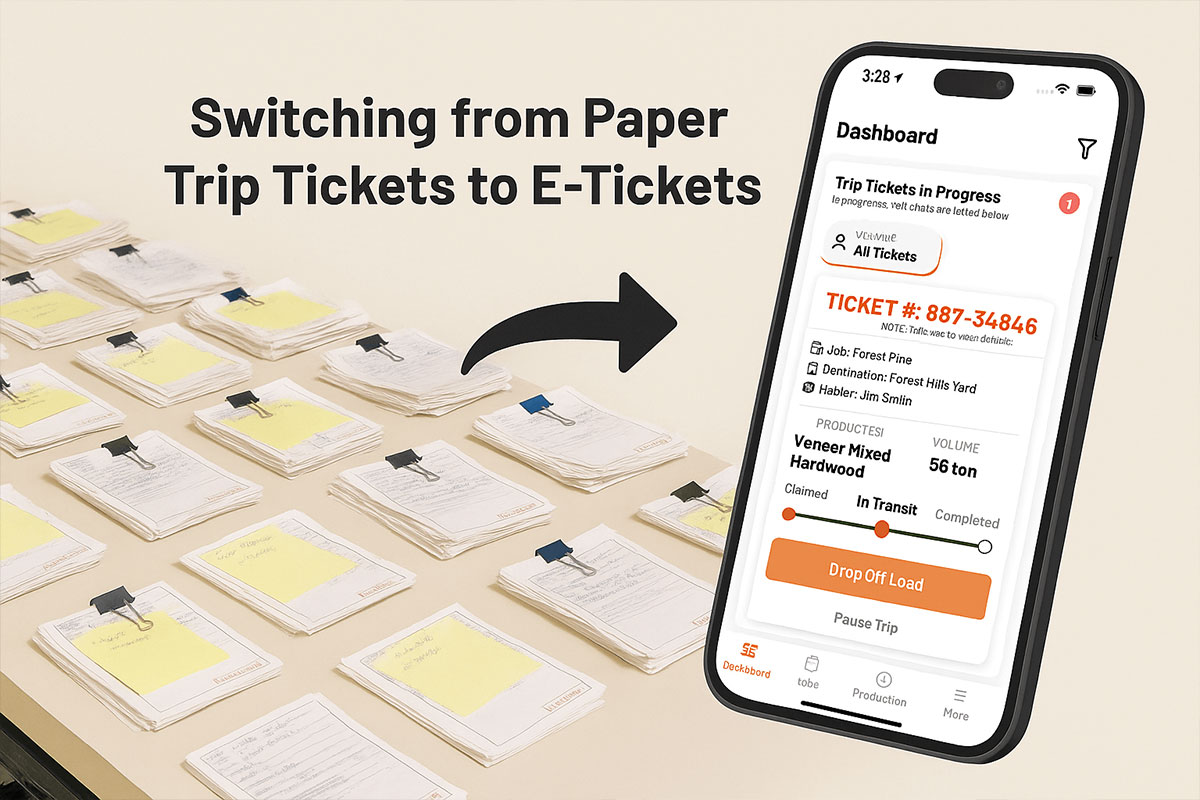
Every conversation about e-tickets ends up here eventually. Doesn't matter if you're a landowner, a mill, or a logging contractor — the same six questions come up, in roughly the same order. So let's just answer them.
This is the one people worry about most, and it's the one that gets solved first.
Truckers don't want software. They want no more paper tickets and no more load reports — full stop. When a ticket means one scan instead of a clipboard and a stack of carbon copies, adoption stops being a fight — guys start asking for it. That's been true from small jobs up through enterprise rollouts: the crews who actually move the wood adopt fastest when the tool removes friction instead of adding a step.
It also has to survive where the work actually happens. No cell service, no satellite hardware, no extra gear — the app works offline in the woods and syncs when it can. Scan a barcode, snap a scale slip, done. One mill that recently rolled this out ran into a small hiccup: a few scalers were manually keying ticket numbers because it felt faster than walking a driver through the barcode screen. The fix wasn't more training — it was a simple reminder taped up in the scale shack. Once barcode-only became the standard, it just worked.
The pattern holds across regions. Second-generation logging outfits in Michigan's Upper Peninsula, long-haul truckers in the Northeast — once a crew tries it on a live job, they don't go back to paper.
View Rowlee Farms Trucking Case Study
Your office team isn't worried about the technology. They're worried about spending their week chasing down paper from the field, re-keying numbers off scale slips, and driving to mills to confirm a delivery that should've been obvious.
That's the job e-tickets actually replace. The load, the scale slip, and the settlement stay tied together from the moment the ticket is created — no double entry, no reconciliation marathon on Friday afternoon. One customer's bookkeeper put it simply: it makes every part of the logging chain easier, from the field to the ledger.
See how AI Ticket Reconciliation is changing the game.
Foresters live in the field and in the numbers at the same time — job setup, quotas, sort changes, contractor coordination. The value here isn't a new system to learn; it's one place instead of five: text threads, spreadsheets, phone calls, and a stack of tickets that may or may not match what actually got hauled.
Editable sort sheets mean a forester can adjust mill specs mid-job without a phone tree. Quota controls mean they see volume in real time instead of finding out a destination is overloaded after the fact. For consulting foresters managing dozens of contractors and jobs at once, that's hours back every week — not a new interface to fight with.
Mills don't want a new system bolted onto scale operations. They want fewer errors and less time reconciling what showed up versus what the paperwork says.
That's the case for mills, too: real-time visibility into inbound loads before they hit the yard, scale slips matched automatically, and a receiving standard that's actually less work than the paper process it replaces. It's not a mandate on the mill — it's an upgrade to how receiving already runs, driven by the same certification and compliance pressure showing up across the industry.
View the 5 Ways Mills Receive E-Tickets
FSC and SFI certification attaches automatically at the point the ticket is created — not reconstructed later from memory or a stack of receipts. GPS and timestamp data ride along with every load, building an audit trail without anyone doing extra work to create it.
That matters more by the month. EUDR is pushing every mill and landowner with EU exposure toward geo-referenced, documented chain of custody — and paper can't produce that on demand. When an auditor or a customer asks for proof, the answer should already exist, not require a week of digging.
See how it simplifies your audit
View State of Maine approval
This is usually the last question, and it's the one that decides the deal.
E-tickets don't have to replace what you're already running — they connect to it. Export to QuickBooks. Integrate with LIMS. Push data through APIs and webhooks into the ERP or accounting system already in place. One Great Lakes landowner mapped their entire job and contract structure directly into their existing LIMS, matching contract numbers and service IDs so nothing got lost in translation. Their own words: it didn't just meet them where they were — it mapped to their system so nothing fell through the cracks.
See Waldo's Methods of Integration
The Common Thread:
Every one of these objections comes from the same place — a track record of software promising ease and delivering more work. The answer isn't a bigger feature list. It's proof, one job at a time, that the field, the office, and the mill can all trust the same record.
If you're weighing this for your own operation, the fastest way to get past all six questions at once is a single-job pilot.
Run one load from stump to mill and see it for yourself.